Articles Posted in Financial Issues in Divorce

Published on:

Bears Legend Wins Divorce Court Battle After Wife Attempted to Seize Majority of Assets

 Posted April 24, 2026
Ranking the 100 best Bears players ever: No. 26, Olin Kreutz – Chicago  Tribune
Another NFL legend has secured a major victory — not under stadium lights, but inside a courtroom where legacy, trust, and financial fairness were at stake.
Published on:

Gathering Your Financial Ducks in a Row: What Documents You’ll Need in the Early Days of an Illinois Divorce
If you’re just starting the divorce process in Illinois, the paperwork can feel like a mountain—especially when it comes to finances. But here’s the good news: pulling together the right documents early on isn’t as scary as it sounds, and it actually makes the whole journey smoother. Think of it as creating a clear snapshot of your household’s money picture so everything (from child support and spousal maintenance to dividing assets fairly) can be handled transparently and equitably.
In Illinois, both spouses are required to complete a standardized Financial Affidavit (Family & Divorce Cases)—the official Supreme Court-approved form—very early in the case. This isn’t optional; it’s a key part of the initial stages, often due within the first 30 days or before asking the court for temporary support or fees. The affidavit details your income, expenses, assets, and debts under oath, and you’ll attach supporting documents to back it up. Getting organized now helps you (and your attorney) avoid delays, show good faith, and set the stage for a smoother resolution.
Published on:

Questions for Michael Roe about Illinois Child Support? Here’s a quick summary of the application of overnight calculations that affect actual child support. 

Recent changes to Illinois divorce law have reshaped how courts handle child support calculations when parents share parenting time almost equally. These updates reflect the state’s ongoing efforts to align financial responsibility with actual time spent with children, a critical issue in modern family law.

Illinois courts determine child support under the Income Shares Model codified at 750 ILCS 5/505. This model allocates support based on each parent’s income and the proportion of time the child spends with them. The 2023 amendments to the Illinois Marriage and Dissolution of Marriage Act clarified that when each parent has the child for at least 146 overnights per year, the “shared parenting” formula must be applied, adjusting both parents’ obligations proportionally.

Published on:

The Landscape of Spousal Maintenance in Illinois

Illinois divorce law continues to evolve, particularly when it comes to spousal maintenance. Talk to Michael Roe at www.illinois-attorney.net if you have questions about spousal maintenance in Illinois.

The Purpose of Maintenance

Published on:

Valuing a Small or Medium-Sized Business in an Illinois Divorce

When a couple divorces in Illinois and one or both spouses own a business, determining the value of that business is an essential step in dividing marital property fairly. Illinois law treats closely held businesses as marital property to the extent they were created or grew during the marriage. The court must therefore determine the business’s fair market value as of or near the date of dissolution.

1. Common Valuation Methods in Illinois Divorces

Published on:

It’s the new year, and a client with a new case just filed emails me to understand what the next steps are in his/her case. Even though the case may feel brand new to a new litigant, financial disclosure comes up quickly. Illinois divorces typically require a Financial Affidavit, which details income, expenses, assets, and debts.

Encourage readers to start gathering:

  • Pay stubs and tax returns
Published on:

Understanding Dissipation of Marital Assets in an Illinois Divorce: In Illinois divorce cases, the concept of dissipation of marital assets can significantly impact the division of property.
            Dissipation refers to one spouse’s wasteful or improper use of marital assets for purposes unrelated to the marriage, often to the detriment of the other spouse. Understanding this concept is crucial for ensuring a fair division of property during divorce proceedings. Under Illinois law, specifically the Illinois Marriage and Dissolution of Marriage Act, marital assets are divided equitably, not necessarily equally.
blog_20241125173005-300x225
           Dissipation occurs when one spouse uses marital funds or property for uniquely personal benefit, unrelated to marital purposes, typically after the marriage has begun to break down irretrievably. Common examples include extravagant spending on items that are exclusive to the purchasing spouse (such as an expensive watch), gambling, funding an affair (travel, dinners, jewelry for a paramour), or transferring assets to hide them from the other spouse. For instance, if one spouse uses marital savings for lavish vacations or gifts to a third party after the marriage   deteriorates, this could be considered dissipation. 
Published on:

Ilyssa Panitz freely admits she gave up the financial reins when she got married.

“I did not keep an eye on the money, even though I got married later in life,” says Panitz, 54, who lives in Westchester County, N.Y. “My former spouse worked in accounting and I was taking care of the kids, and I figured ‘This is great’.”

Then, after 13 years of marriage, says Panitz, who hosts the nationally syndicated radio show, “The Divorce Hour with Illyssa Panitz,” she told her husband she wanted to split up. And she realized her ignorance about their money situation “was my biggest mistake and biggest downfall. I had the rug pulled out from under me.”

Published on:

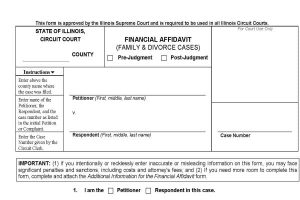
In Illinois, divorcing parties fill out a Financial Affidavit statewide form to provide a clear and comprehensive snapshot of their financial situation during the divorce process. This form is a standardized document that helps promote transparency and fairness when it comes to dividing assets, determining spousal support (alimony), and, if applicable, calculating child support. Illinois law imposes legal duties on parties to complete the form truthfully and to make full disclosures of income, expenses assets and liabilities.  
Illinois-Statewide-Forms-APPROVED-Financial-Affidavit-Family-Divorce-Cases-081518_Page_1-Cropped-300x200
The affidavit requires each party to disclose details about their income, expenses, debts, and assets. This information is crucial because Illinois follows an “equitable distribution” approach to dividing marital property, meaning assets and debts are split in a way that’s deemed fair, though not necessarily equal. The financial affidavit gives the court—and the attorneys involved—a factual basis to make informed decisions about what’s equitable based on each spouse’s financial circumstances.
It’s also tied to Illinois law, specifically the Illinois Marriage and Dissolution of Marriage Act, which mandates full financial disclosure to prevent either party from hiding assets or income. Without this form, it’d be harder to verify claims about financial need or ability to pay support, which could drag out the process or lead to unfair outcomes.

Published on:

The question of child support seems to be a basic question, but one that sometimes causes confusion. It used to be some years ago that the noncustodial parent was obligated to pay child support to the parent with the “primary custody of the child or children.”  Illinois has largely done away with old concepts of child custody and child support, and now centers its laws on allocating more equally the parenting time of the children, and setting support such that both parents’ incomes are factored in.

Child support is now calculated using an “income shares” model, which considers both parents’ incomes and the number of children. The key factors in determining child support include:

1. Determining Both Parents’ Net Incomes

Contact Information